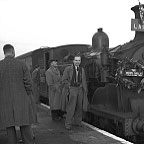
Richard ‘Dick’ Riley’s interest in railways was kindled, in part, because he lived within easy reach of Dulwich where the Union bridge between West Dulwich and Sydenham Hill provided a continual stream of steam trains, not least of which was the ‘Golden Arrow’. His home station of Tulse Hill provided all sorts of Brighton engines shunting the goods yard or the milk loading bay, and one Portsmouth express each afternoon. Richard attended a City school and so commuted to Holborn Viaduct, where apart from the native ex-SE&CR engines, there were ex-GNR and ex-MR engines on freight trains to the SR via the ‘Widened Lines’ and Snow Hill tunnel, now reopened.
Inevitably, Richard’s first camera was a Box Brownie and his first attempt at LNER No. 4473 ‘Solario’ moving out of King’s Cross was a disaster. In 1937, he acquired a Kodak folding camera with a speed of 1/100, but this was still unsuitable for moving trains. Then came the war, after which Richard tried a Zeiss Ikonta with a speed of 1/250 with some degree of success. However, it was not until Richard started doing his own developing and printing, coinciding with his admission to Maurice Earley’s Railway Photographic Society in 1954, that Richard’s work began to improve.
By this time, Richard had moved from recording locomotives to recording the train in its environment. Like Maurice Earley, Richard worked in a bank, which meant that for many years he could not record the busy summer Saturday morning traffic. Many of his holidays were spent recording railways, often in the West Country, even on some occasions taking a roll film developer with him!
Richard’s favoured combination was Ilford FP3 film with Promicrol developer. In 1955, he acquired a second-hand Agfa Isolette with a speed of 1/500, followed by an Agfa Record 3 giving 2 ¼ x 3 ¼ inch negatives rather than 2 ¼ inch square. Richard never paid more than £20 for a camera for black and white photography.
In 1954, Richard started taking colour transparencies, but hampered by a lens of f3.5 and slow Kodachrome 8 ASA film again could not take moving trains. This was rectified in 1957 when he purchased an Agfa Silette with f2 lens. In later years, Richard used a Canon SLR f1.8 camera that he acquired in 1967. Richard passed away on 23 July 2006 and is survived by his wife Christine, and sons David and Philip.
This is the first time that Richard Riley’s negatives have been listed and made available to publishers and enthusiasts alike. Take this exciting opportunity to browse the list and acquire your own pictures taken by one of the truly great British railway photographers.